10th Grade World Literature

 Sample QQR Journal

This is a QQR journal I was working on for one of my pleasure reads, Gormenghast by Mervyn Peake.  Your journal does not have to be identical to mine, but please observe the following:

  • Chapter #'s are clearly indicated to the left.
  • Quotations are cited using MLA style.  Click HERE for information on how to cite using MLA.  Or, consult the PurdueOWL website -- it's awesome.
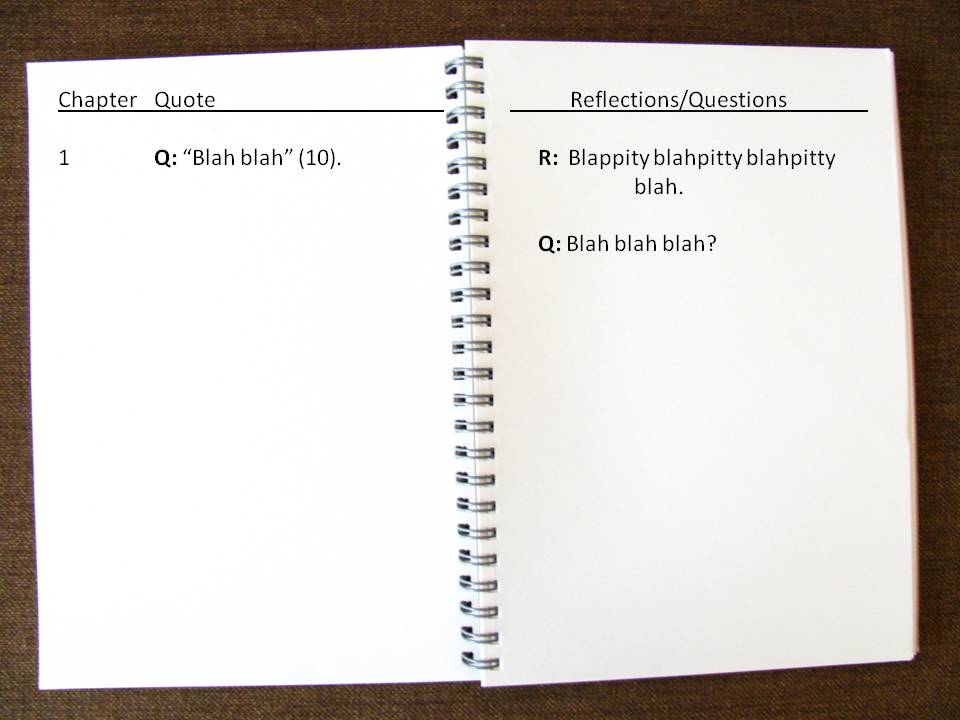
  • Quotations and reflections/questions are SIDE-BY-SIDE and lined up (I want to be able to look at them all at the same time).  You can accomplish this by making a table, like mine, or by using two sides of a notebook, as such:

Ms. Kalmar's QQR Journal

Gormenghast, by Mervyn Peake


Ch. #

Quotes

Reflections & Questions

10

Q: “He evinced so brutal a disregard for his own and other people’s windpipes as made one wonder how this man could share the selfsame world with hyacinths and damsels” (408).


Q: “His teeth were both carious and uneven and were his worst feature” (408).

R: Peake is such a master at: a) concrete detail and b) avoiding cliché.  Instead of, “How could something so evil exist in a world full of such good things?” he gives us vivid, physical objects to imagine.  He’s so fresh, so real – so GOOD!  I really wish that I could write as well as Peake does – I think that his background as an artist probably really gives him a leg up when it comes to crafting powerful imagery.


R: “Carious”… yet another word that I’m going to have to go look up.  My new word list is about twenty times longer for this novel than anything I’ve read in the last four years, including a lot of technical readings for college classes.


Q: Are the professors going to become more important in the story?  Recently we’ve read a lot about them, but we barely knew they existed until a few chapters ago.

Q: Where did Peake pick up his unusual vocabulary?  Why does he feel the need to drop such big words constantly?

13

Q: “I don’t believe in draughts.  I don’t believe I’m cold.  I don’t believe in anything! ha, ha, ha, ha, ha!” (424)

R: What a perfect setting for exposing the follies of modern thought and philosophy.  It’s cheating, really, like most satire – we’re only getting a caricature of a real philosophical position.  But I can’t help but think that [C.S.] Lewis would be delighted by this chapter… bad belief/distortion of the truth eventually leaks out into the physical world and produces deformities in soul and matter… deformities that in art we might sometimes call stylization!


This entire chapter would be an awesome excerpt for my students during their study of The Plague.  We could talk about how it portrays existentialist thought.


Q: What were Peake’s religious/philosophical beliefs?  I don’t know much about the guy as a person, just as an author/artist.

14

Q: “It was in Bellgrove’s class, one late afternoon, that Titus first thought consciously about the idea of colour…” (430).

R: Again, Peake’s artistic soul is laid bare.  This begins an absolutely brilliant (in mind, hue…) chapter inside Titus’ head.  The imagery is magnificent – perhaps another good teaching tool!


Q: Is Titus’ freedom from the castle going to be physical, mental, emotional, intellectual, spiritual, or all of the above?  Will he attain freedom in ALL of these areas, or is he always going to be a slave to one or another?


This free website was made using Yola.

No HTML skills required. Build your website in minutes.

Go to www.yola.com and sign up today!

Make a free website with Yola